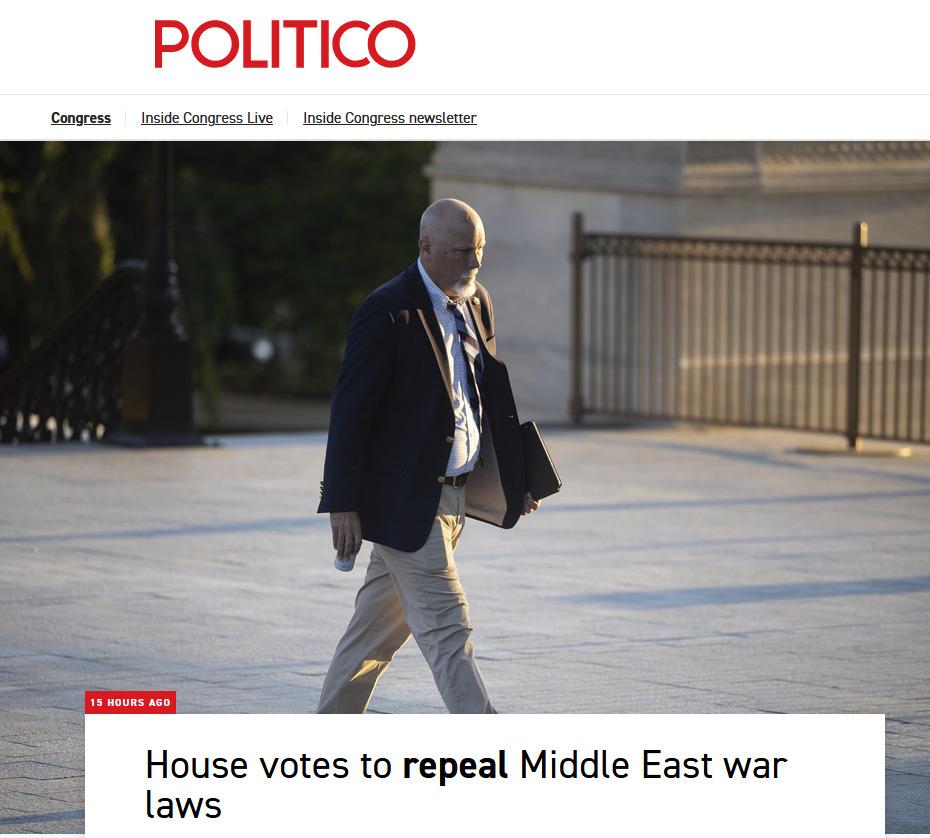
📰 Headline: “House votes to repeal Middle East war laws”
Politico, 15 hours ago
🔍 What Happened?
The U.S. House of Representatives has voted to repeal the 2001 and 2002 Authorizations for Use of Military Force (AUMFs) that have enabled U.S. military action in the Middle East for over two decades.
These laws were originally passed after the 9/11 attacks and the Iraq War, respectively. They have been used to justify military operations in Iraq, Afghanistan, Syria, Yemen, and elsewhere — often without clear congressional oversight.
This vote marks a historic shift toward ending perpetual war and restoring congressional authority over military decisions.
✊ Political Analysis from a Civic & Human Rights Perspective
As a nonpartisan, charitable organization focused on constitutional reform, anticorruption, and democratic development, the National Council of Iraqi Opposition (NCIO) welcomes this move as a step toward accountability, transparency, and peace.
✅ Why This Matters for Iraq:
- End to Unilateral U.S. Intervention
- For years, U.S. military presence in Iraq was justified under these AUMFs.
- The repeal signals a move away from endless wars and toward diplomatic solutions.
- It could reduce the risk of future military escalation in the region.
- Restoring Congressional Oversight
- The U.S. Constitution gives Congress the power to declare war.
- Repealing these laws brings back democratic accountability.
- Future military actions will require clear, specific authorization — not broad, open-ended mandates.
- Support for Iraqi Sovereignty
- Iraq has long suffered from foreign military interventions.
- A U.S. withdrawal based on law and consent would be a victory for Iraqi independence.
- It could create space for Iraqi-led security solutions and regional diplomacy.
- Reducing Civilian Suffering
- Decades of conflict have killed over 1 million Iraqis and displaced millions.
- Ending unchecked military action may help protect civilians and support reconstruction.
⚠️ Challenges Ahead
While this is a positive step, it is only the beginning:
- The Senate must now act — and may face resistance from hawkish factions.
- The U.S. still maintains troops in Iraq under security agreements — which are separate from the AUMFs.
- The Biden administration may seek new authorizations or use existing powers (e.g., executive orders).
🤝 The Role of the NCIO
The NCIO supports:
- Peaceful, lawful, and democratic solutions to conflicts.
- Respect for Iraqi sovereignty and international law.
- Transparency in U.S.-Iraq relations.
- Civil society engagement in shaping foreign policy.
We call upon:
- The U.S. Congress to pass this bill into law.
- The U.S. government to engage in dialogue with Iraqi authorities on troop withdrawal.
- The international community to support Iraq’s democratic transition and human rights reforms.
💬 Final Thought
“War without end is not strength — it is failure.
True leadership means knowing when to fight, and when to stop.”
— Mohammed Alkhaledi, Director, NCIO
Let us hope this vote marks the beginning of a new era — one of peace, justice, and dignity for the people of Iraq and the entire Middle East.
About the Author